Six pieces, one stance
The armor of God, piece by piece
Paul ends Ephesians with a soldier getting dressed. This path reads Ephesians 6:10-18 one piece at a time, asks what each image meant to readers who knew what a Roman soldier looked like, and keeps the point in view: stand.
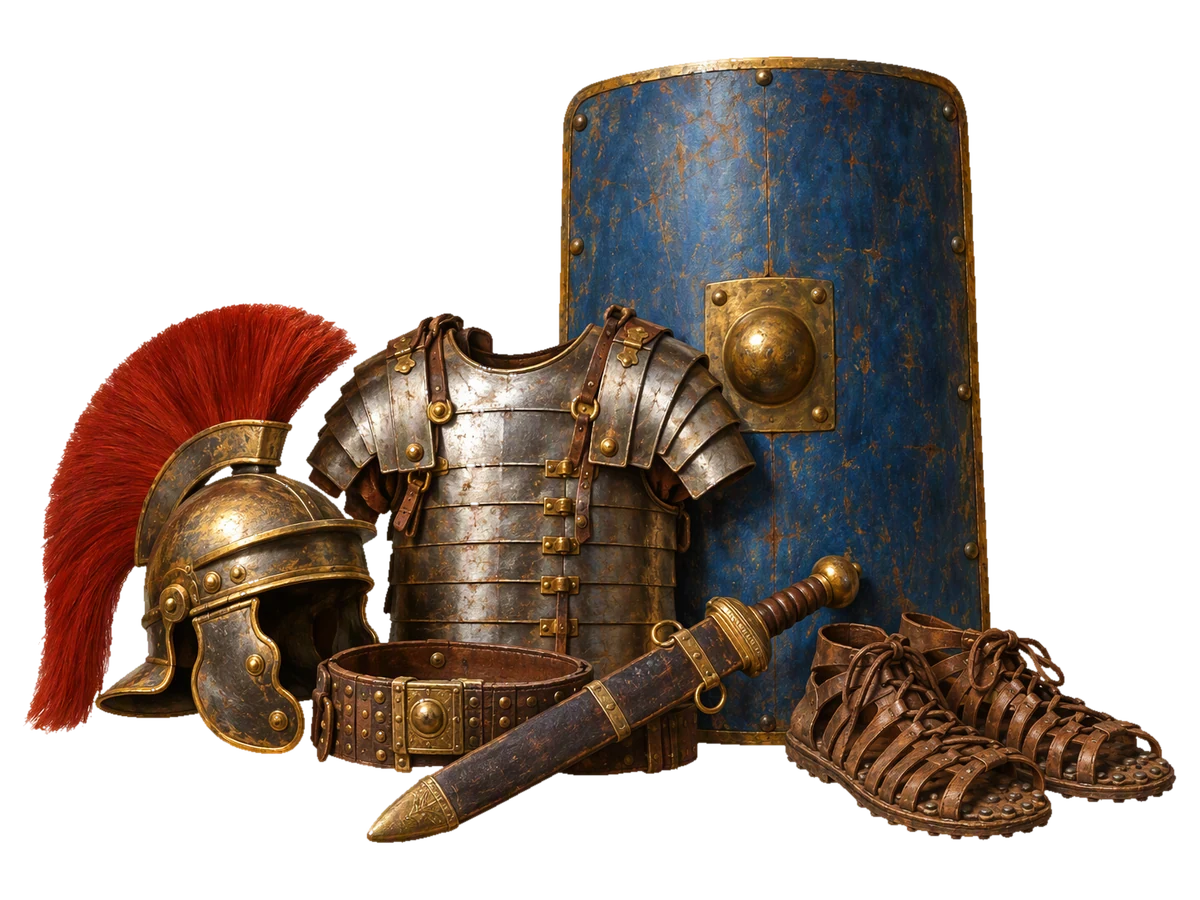

Put on the whole armor of God, that you may be able to stand against the wiles of the devil.
What you'll come away with
What this path is for
Not a reading streak. These are the things you should be able to do on your own once you have worked through it.
Name every piece
Belt, breastplate, shoes, shield, helmet, sword. You will know what each one stands for in Paul's own words.
Know who the fight is with
Paul says the struggle is not against flesh and blood. You will see why that rules out treating people as the enemy.
Read it as the end of a letter
The armor closes a letter about grace, unity and ordinary households. You will read it in that setting, not as a stand-alone passage.
Finish with prayer
The passage ends in prayer, not a weapon. You will see why verse 18 belongs to the armor.
How the tutor works
A tutor, not a search box
The same eight habits run through every path. They are what make this study rather than summary.



Questions first
Every lesson asks before it tells. A few quick questions check what you noticed, then Trinity explains the answer.

Greek and Hebrew, one tap away
Tap a word to see the Greek or Hebrew behind it. See what it can mean and where else it shows up.

Follow the thread
Pick one image, promise, or line. Follow it from Genesis through the prophets into the Gospels.
- Map
Galilee
LetterPhilippians
- From
- Paul, in prison
- To
- the church at Philippi
- Why
- thanks, and joy
TimelineWhere it sits
- Abraham
- Moses
- David
- Exile
- Jesus

Context that clicks
Maps, timelines, and who wrote it to whom. Get the background the first readers already knew.
 Genesis
 Exodus
 Psalms
 Beatitudes
 John
John Hebrews
 Lord's Prayer
 Parables
 Acts
Acts Corinthians
 Romans
 Revelation
 Isaiah
 I AM Sayings
 Proverbs
26 paths and counting
Walk through a whole book, Genesis to Revelation, or take a short theme like the Beatitudes or the Lord's Prayer.
Bring your doubts
Ask the question you'd never ask out loud. Trinity takes it seriously, no judgment.
 Feb5
Feb5Maya's questions
Added 6w agoWants to know why Jesus calls the poor blessed. Reads on the train.
Apr12Next up
Just addedBeatitudes, lesson 3: the gentle. Her Bible says meek, so start there.



Pick up where you left off
Trinity keeps notes on your questions and where you stopped. Next time, it starts right there.
Every side, fairly told
On baptism, the end times, and more, you get the main views and their best arguments. Disputed questions are labelled as disputed.
The path itself
What you'll study, in order
Each unit builds on the one before it. Lessons live inside Trinity; this is the shape of the ground you will cover.
Getting ready
Where Ephesians is going
Be strong in the Lord
Not flesh and blood
The evil day
Standing firm
The belt of truth
The breastplate of righteousness
Shoes of peace
Guarding and fighting
The shield of faith
The helmet of salvation
The sword of the Spirit
Staying alert
Praying at all times
Praying for others
Isaiah's armor behind Paul's
I've led a small group for six years, and honestly I was mostly repeating Sunday's sermon. Trinity kept asking what the passage actually said before it would tell me anything. Our Thursday nights are better for it.
I was baptized in March and still couldn't find anything in the Bible. I asked what a psalm even is, which felt embarrassing to type. It showed me Psalm 13, a man complaining to God. I didn't know that was allowed.
I mostly use it for word study. When I'm stuck on a Greek term, it walks me through what it can mean without pretending the question is settled. It's told me "scholars disagree here" more than once, which I respect.
Forty years in church and I'd never finished the Bible. I'm in Numbers now. Not thrilling, but I'm still going. Most days I read it before the kettle's boiled.
I'm not sure I believe any of it yet. I came in wanting to argue, and I still do. It argues back properly. It names the best objection before I can, and it doesn't sulk when I won't concede.

I ask it what a fifteen-year-old would really ask about a chapter. It gives me the awkward questions, not the tidy ones. Twice now it's sent me off to study properly, which I suppose is the point.
I read on my phone during my eleven-minute break, and it never tries to make it an hour. Last week it caught that I'd misread who was speaking in Job. It was one of the friends, not God. Changed the whole chapter for me.
I work in two languages, so I'm fussy about words. I asked why one Hebrew word is lovingkindness in one place and steadfast love in another. I got a real answer about hesed, not a devotional paragraph.
I worried it would hand my people easy answers to hard chapters. It mostly doesn't. Someone asked it about hell, and it laid out what Christians have held and said plainly which parts are disputed. I can work with that.
I sit with dying people, so I don't have much patience for cheerfulness. I'd been avoiding the lament psalms. It walked me through Psalm 88, which ends in the dark and stays there, and it didn't rush to fix it.
I'd abandoned three reading plans before this one. I went quiet for a while, came back, and it just carried on. No lecture. I'm in Isaiah now.
Before you start
Questions people ask about this path

Yes, and Christians picture that in different ways, from quiet daily faithfulness to more direct prayer against evil. The path stays close to what Paul actually says and presents the main readings calmly.
Several come from Isaiah, where God himself puts on righteousness as a breastplate and salvation as a helmet (Isaiah 59:17). Paul hands that armor to the church. The path reads the Isaiah passages alongside.
About three weeks at a few short lessons a week. It is one of the shortest paths on Trinity, which makes it a good first one.
Start this path today
The first unit is free, and you do not need to know anything going in. Trinity will ask what you noticed before it explains a thing.
Join the waitlist